Is a Deck of Cards Secretly a Calendar? The Math Works. The History Doesn't.
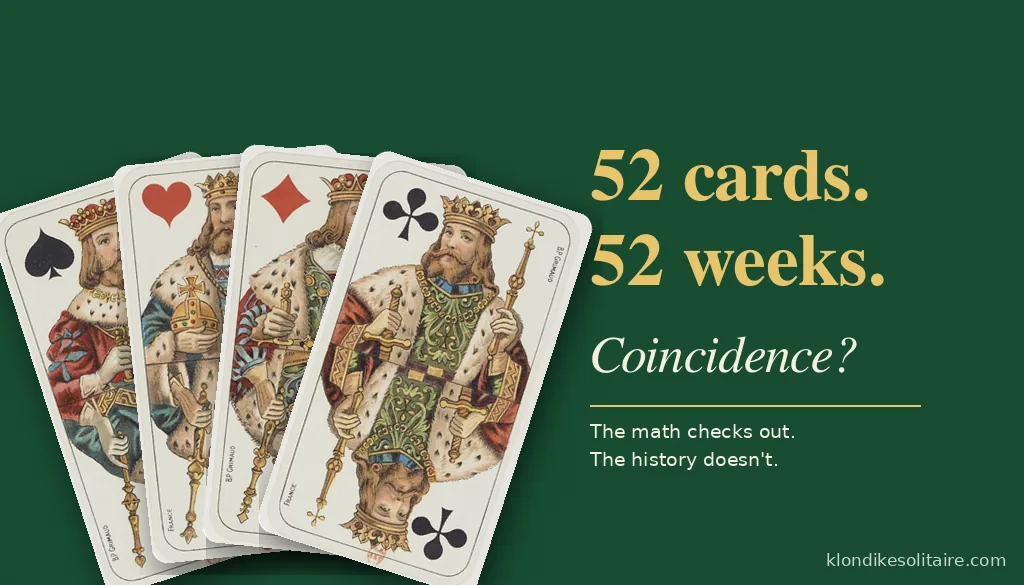
You've seen the post. Maybe a grandparent told you. Maybe it was a chain email, a TikTok, a guy at a bar who leaned in like he was about to hand you a secret:
52 cards for 52 weeks. Four suits for four seasons. Thirteen cards in a suit for thirteen weeks in a quarter. Add up every card and you get 364 — toss in the joker and it's 365. Red and black for day and night. The deck isn't a game. It's a calendar.
It's a great story. And here's the thing that makes it dangerous: the arithmetic is completely, verifiably true. You can check it yourself in thirty seconds, and once you have, the "designed as a calendar" conclusion feels earned.
It isn't. The deck of cards was never designed to be a calendar. We can prove it — not by hand-waving, but with dates. The 52-card deck existed before anyone in Europe had seen one, the joker showed up about five centuries too late to be part of the plan, and the "four social classes" story falls apart the moment you learn what the French word for "diamonds" actually means.
Let's do this properly. First the part that's true. Then the part nobody mentions.
First, the part that's true
Give credit where it's due. Every number in the legend checks out:
- 52 cards, 52 weeks. ✔ Yes.
- 4 suits, 4 seasons. ✔ Yes.
- 13 ranks per suit, 13 weeks per quarter. ✔ Yes, 52 ÷ 4 = 13.
- 12 court cards, 12 months. ✔ Jack, Queen, King × 4 = 12.
- Add every card and you get 364. ✔ Ace = 1 through King = 13 sums to 91 per suit. 91 × 4 = 364.
- One joker makes 365. Two make 366. ✔ If you count each joker as 1, sure.
- Two colors, day and night. ✔ Red and black. (Not "black and white" — that version of the legend can't even get the colors right.)
So far, so spooky. This is exactly why the myth survives: it hands you a calculator and says "don't take my word for it." And the calculator agrees.
The calculator is not the problem. The history is the problem.
The deck was 52 cards before Europe ever saw one
This is the single fact that ends the argument, so let's put it first.
Playing cards were not invented in Europe. They came from China — paper "leaf" games are recorded there by around the 9th–10th century — and travelled west through the Islamic world. By the 15th century, the Mamluk Sultanate in Egypt was producing luxurious hand-painted decks, and one nearly complete example survives today in the Topkapı Palace Museum in Istanbul.
Count the Mamluk deck: 52 cards. Four suits. Thirteen ranks in each — ten pip cards and three court cards (a king and two deputies). The suits were cups, coins, swords and polo sticks. No hearts. No spades. No jokers. And no Christian calendar, no Julian year, no "four seasons of the temperate zone" — just a card game from Cairo.
The 52-card structure the legend explains as a European calendar was already fixed before it crossed the Mediterranean. Whatever the numbers "mean," they didn't mean it to the people who chose them.
Europe couldn't decide on 52 for two hundred years
Cards reached Europe in the 1370s. We know this with unusual precision because they immediately started getting banned: Florence outlawed them in 1377, and Paris had restricted them by 1397. And in 1377, a Dominican friar in Basel named Johannes of Rheinfelden sat down and wrote the first detailed description of playing cards in European history.
Johannes describes the common form as four suits of thirteen — but he also describes decks of 48, 52 and 60 cards, with four, five and six suits. Nobody had settled on anything. And they kept not settling:
- Germany went its own way with hearts, bells, acorns and leaves — and many German games still use 32- or 36-card decks today.
- Spain drops the 8s and 9s and plays with 40 cards. Or 48. Depends who you ask.
- Italy in the 1430s–40s added a fifth suit of 22 permanent trumps to make the 78-card tarocchi deck — a trick-taking game, nothing mystical about it yet.
- France, around 1480, invented the suits we use — and won, for a wonderfully unromantic reason we'll get to.
If the 52-card deck were a calendar, it would be strange for half of Europe to keep cheerfully playing with 32, 40 and 78. Nobody was protecting the calendar because there was no calendar to protect. The 52-card French pack became the international standard the way most standards win: it was cheap, it was everywhere, and the British and then the Americans exported it.
The joker showed up 500 years late
Remember the neat trick that gets you from 364 to 365? "Just add the joker."
Here is the problem. The joker is an American invention from the 1860s. Card makers added it as an extra top trump for the game of Euchre, which was booming at the time; it was called the "Best Bower" or "Imperial Bower" before anyone called it a joker. That is roughly five hundred years after the 52-card deck reached Europe.
Think about what the legend is asking you to believe: that someone designed a calendar, got it wrong by one day, and then waited half a millennium for a Euchre craze in the United States to fix the leap year.
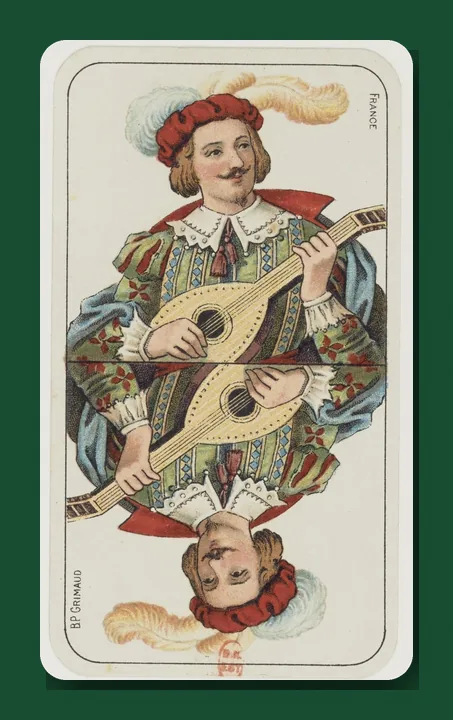
The card on the left is often mistaken for the joker's ancestor. It isn't. That's the Fool from a French tarot deck — a trump card that dates to the 1400s and has nothing to do with Euchre. The Fool and the joker look alike because a jester is a jester; they aren't related. The joker's real ancestor is a marketing decision in Civil War–era America.
The "four social classes" story falls apart when you learn French
The more sophisticated version of the legend skips the calendar and goes for sociology. The four suits, it says, encode the estates of medieval society: hearts for the clergy, spades for the nobility and its soldiers, diamonds for the merchants, clubs for the peasants.
It's tidy. It's also an interpretation that was pinned on the suits afterwards, and it doesn't survive contact with the actual words.
The French suits were created around 1480 in Rouen and Lyon, and their great innovation was economic, not symbolic. The older Italian suits — elaborate cups, swords, coins and batons — had to be woodcut and hand-coloured. The French replaced them with four flat shapes in two colours that could be stencilled. That's it. That's why a deck of cards looks the way it does: a pike, a heart, a clover and a paving tile were the cheapest four shapes to mass-produce.
Yes, a paving tile. In French the "diamond" suit is a carreau — a square floor tile. The suit that supposedly stands for merchants and their wealth is named after flooring. The clover (trèfle) is only a "club" in English because English speakers inherited the word from the Italian and Spanish bastoni / bastos (batons) and kept using it after the picture changed. Same with "spades": it's not a shovel, it's the Italian and Spanish spade / espadas — swords — wearing a French pike's clothing.
So the English suit names come from one deck, the symbols come from another, and the "four estates" reading was fitted over the top of both. Different countries even assign the estates differently; the mapping is not stable enough to have been anyone's design.
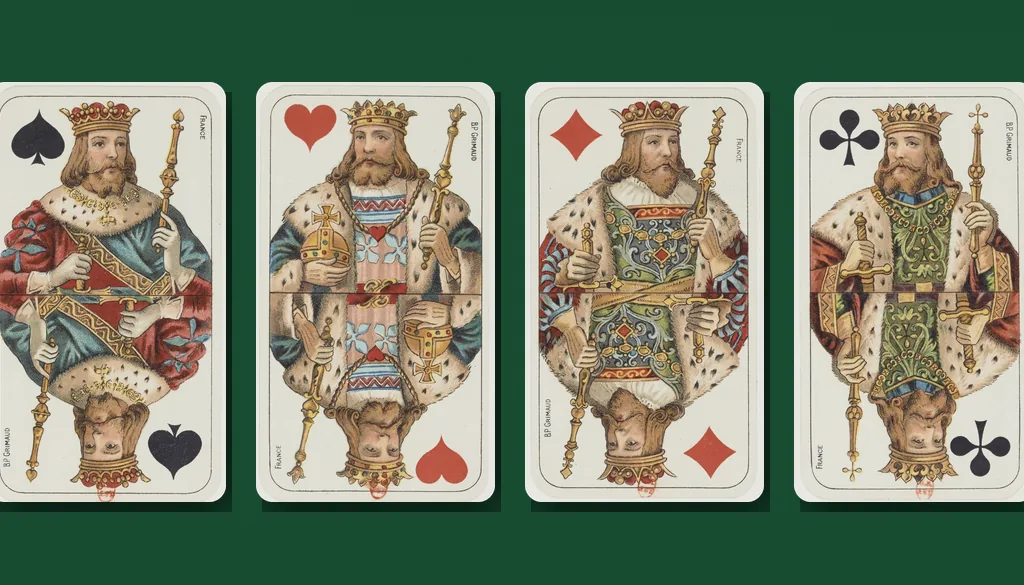
The French did put real people on their court cards, and this part is genuinely documented: in the traditional Paris pattern the King of Spades is David, the King of Hearts is Charlemagne, the King of Diamonds is Caesar, the King of Clubs is Alexander. The queens include Pallas, Judith, Rachel and "Argine" — which is just an anagram of regina, because they'd run out of famous women. That is what actual card-maker intent looks like: cheerful, a bit random, and written down.
"Thirteen lunar months" — there are 12.4
One more piece of the legend deserves a closer look, because it's an error the legend makes about itself.
The polished version says 13 cards per suit matches "the thirteen lunar cycles in a year." It doesn't. A lunar month is 29.53 days, and a year contains about 12.37 of them. The "13 months of 28 days" idea only exists because 13 × 28 = 364 — which is to say, it was reverse-engineered from the number of days, not observed in the sky. The deck isn't matching the moon. The moon is being adjusted to match the deck.
Where the story actually comes from
If no card maker designed a calendar, who did?
A soldier. Or rather, a story about a soldier. British chapbooks from the 1760s carried a tale usually titled The Perpetual Almanack, or the Gentleman Soldier's Prayer Book: a private is caught with a deck of cards in church and, hauled before the mayor, explains that the deck is his bible and his almanac — the ace reminds him of one God, the four suits of the four seasons, the 52 cards of the 52 weeks, and so on. He is, of course, acquitted, and the mayor is deeply moved.
That tale is nearly 400 years younger than the deck it explains. It survived as a sermon, was recorded as the spoken-word single "Deck of Cards" by T. Texas Tyler in 1948, became a top-ten hit for Wink Martindale in 1959, and has been re-shared as fact ever since. It was never a design document. It was a devotional set-piece — and a very good one.
Why the pattern feels so real
Humans are pattern-finding machines, and numerology is what happens when the machine runs without a brake. Small numbers overlap constantly. Give any structured object enough time and someone will find the calendar in it.
A piano has 52 white keys. Nobody thinks a piano is a calendar.
The "52 weeks" itself is a rounding: a year is 52 weeks and a day, which is why the legend needs the joker in the first place. Twelve court cards for twelve months is nice until you remember Italian and Spanish decks have a fourth court rank, the knight, and therefore sixteen. Every "match" holds only if you pick the one deck, the one counting rule and the one calendar that make it hold.
Tarot went through exactly the same process. It was a trick-taking card game in northern Italy for 350 years before a French clergyman, Antoine Court de Gébelin, announced in 1781 that it secretly preserved the wisdom of ancient Egypt. There was no evidence then and there is none now — but the story was better than "it's a game," so the story won. The calendar deck is the same move with a different costume.
The verdict, claim by claim
| Claim | Arithmetic | History |
|---|---|---|
| 52 cards = 52 weeks | True | 52 was fixed in Mamluk Egypt; Europe used 32, 40, 48 and 78 for centuries |
| 4 suits = 4 seasons | True | Mamluk suits were cups, coins, swords and polo sticks |
| 13 ranks = 13 weeks per quarter | True | Follows from 52 ÷ 4; nothing to explain |
| 13 ranks = 13 lunar months | False | A year has ~12.4 lunar months |
| All pips sum to 364 | True | Coincidence of 1+2+…+13 = 91 |
| Joker makes 365 | True, if joker = 1 | Joker invented in 1860s America for Euchre |
| Red/black = day/night | True-ish | Two colours because stencilling two inks is cheap |
| Suits = four estates | — | Later interpretation; "diamonds" means floor tile; names and symbols come from different decks |
TL;DR: The numbers are real and the story is not. The 52-card, 4-suit, 13-rank deck existed in the Islamic world before Europe had seen a playing card; Europe then spent 200 years playing with 32, 40, 48 and 78-card packs; the French suits were chosen because they were cheap to stencil; and the joker that "fixes" the calendar was invented in the 1860s for Euchre. The calendar reading comes from an 18th-century sermon about a soldier, not from any card maker. Satisfying numerology, retrofitted meaning.
None of which makes the deck less beautiful. If anything it's better: a design so good that four countries, two religions and six centuries kept finding new things it must secretly mean. Go shuffle it. It's still 364 days of pips, and you can play a game of Klondike Solitaire with the very cards pictured above — they're a 19th-century Grimaud deck scanned by the Bibliothèque nationale de France, one of the historic decks in our gallery.
Frequently asked
Is a deck of cards based on the calendar?
No. The numbers line up, but the 52-card structure already existed in Mamluk Egypt before it reached Europe, and no card maker ever documented a calendar intent. The reading is folklore that appeared centuries later.
Do the card values really add up to 365?
Almost. Ace = 1 through King = 13 gives 91 per suit and 364 for the deck. You reach 365 only by counting a joker as 1 — and jokers arrived in the 1860s, about 500 years after the deck.
Do the four suits represent the four social classes?
That's a later interpretation. The French suits were chosen around 1480 because they were easy to stencil in two colours. The "diamond" is a carreau, a floor tile, and the English words "spades" and "clubs" come from the swords and batons of older Latin-suited decks.
Where does the "deck of cards is a calendar" story come from?
An 18th-century British chapbook, The Perpetual Almanack, or the Gentleman Soldier's Prayer Book, popularised by the 1948 record "Deck of Cards" and Wink Martindale's 1959 hit version.
Sources and further reading
- David Parlett, The Oxford Guide to Card Games (Oxford University Press, 1990) — the standard history of the deck and its national patterns.
- Michael Dummett, The Game of Tarot (Duckworth, 1980) — the Mamluk lineage and the origins of tarot as a game.
- Johannes of Rheinfelden, Tractatus de moribus et disciplina humanae conversationis (Basel, 1377) — the earliest European description of playing cards.
- The Topkapı Palace Museum Mamluk deck — see L.A. Mayer, Mamluk Playing Cards (Brill, 1971).
- The International Playing-Card Society — pattern histories and dating.
- Snopes: "Deck of Cards" — on the soldier's tale and the recordings.
- Card images: B.P. Grimaud tarot, Gallica / Bibliothèque nationale de France, public domain. See where to find hi-res playing card scans.