How Many Klondike Solitaire Games Are Winnable? We Solved 8,000 Deals
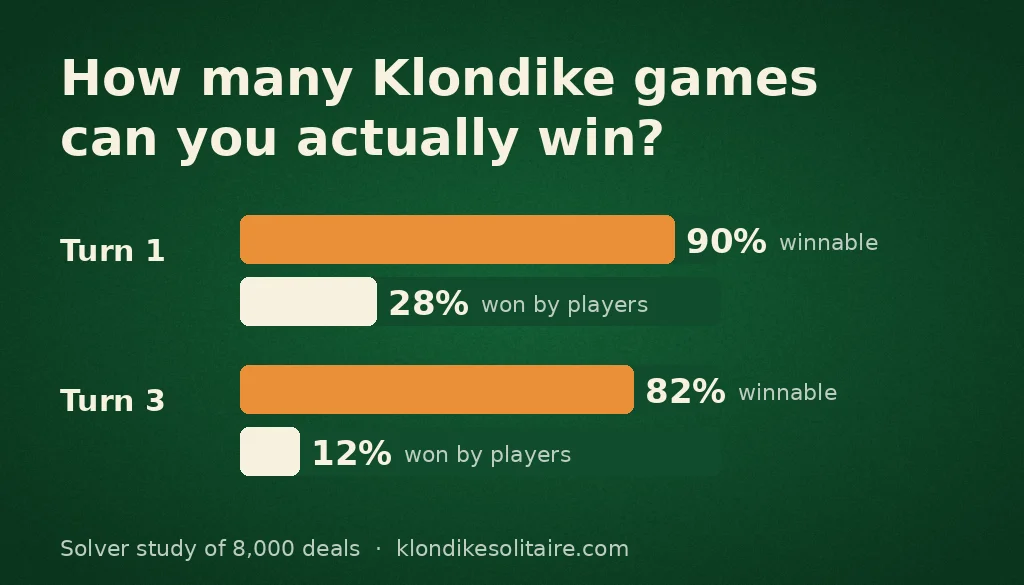
Short answer: about 90% of Turn 1 (draw-one) Klondike deals and about 82% of Turn 3 (draw-three) deals can be won with perfect play. Players on this site win 28% and 12% of the games they start. The deals aren't the problem.
"Most solitaire games are unwinnable anyway" is something people say after a loss. It's comforting, and it's wrong. We ran a solver over 8,000 deals dealt by this site's own shuffle, set the results next to roughly 11,000 games played here, and published every verdict so you can check our work.
What "winnable" means
A deal is winnable if some sequence of legal moves gets all 52 cards onto the foundations. Not a sequence you could find by playing it blind — any sequence at all. Researchers call this thoughtful solitaire: the same Klondike rules, but the player can see every card, including the face-down ones. It's the only way to ask the question cleanly, because the answer then belongs to the deal, not to the player.
The rules we solved are the ones this site plays:
- Seven tableau columns of 1 to 7 cards, top card face up; 24 cards in the stock.
- Draw one card (Turn 1) or three (Turn 3), with unlimited passes through the stock.
- Build down in alternating colours; only a king (or a run headed by one) goes into an empty column.
- Cards may come back off the foundations onto the tableau.
The best published answer
This question has a real answer now, and it's recent. In 2026 Charlie Blake and Ian Gent of the University of St Andrews published the result of solving one million deals of each variant with an exact solver — about 870 CPU-days of computing. For thoughtful Klondike with unlimited redeals they found:
- Turn 1: 90.48% ± 0.12% of deals winnable
- Turn 3: 81.95% ± 0.08% of deals winnable
If someone tells you "only 1 in 3 games can be won", they're describing human results, not the cards.
Our study: 8,000 deals from this site's shuffle
We didn't set out to beat a million deals. We wanted to know whether the deals this site hands out behave like the textbook ones, and we wanted per-deal answers we could connect to how people actually play. So we wrote a full-rules solver, matched its rules to Blake and Gent's so the numbers are comparable, and ran it on 4,000 deals per variant. Each deal comes from the exact shuffle the game uses, so any of them can be replayed.
A solver can return three verdicts. Win: it found a line that clears the board. Lose: it searched every reachable position and none of them wins. Unresolved: it hit its budget of 500,000 positions first. The unresolved deals could go either way, so the honest result is a range:
| Turn 1 | Turn 3 | |
|---|---|---|
| Proven winnable | 3,514 (87.9%) | 3,134 (78.4%) |
| Proven unwinnable | 180 (4.5%) | 513 (12.8%) |
| Unresolved at 500,000 positions | 306 (7.7%) | 353 (8.8%) |
| Winnable share lies between | 87.9% and 95.5% | 78.4% and 87.2% |
| Blake & Gent (1M deals) | 90.48% | 81.95% |
A solver that says "win" has to be right, so every winning line it found was also replayed, move by move, by a separate program that only knows the game's rules as a player experiences them: drag a face-up card, draw from the stock, turn the waste over. All 1,948 lines the full solver found replayed to 52 cards on the foundations; a typical winning Turn 1 line takes a player about 240 actions, a Turn 3 line about 150.
Both published figures sit inside our ranges, so the deals here are ordinary Klondike deals. The whole run took about eight CPU-hours on a desktop; a typical deal is settled in well under a second, and the long tail of hard deals is what the unresolved row is made of.
What players actually win
Now the other half. Between September 7 and October 23, 2026, players on klondikesolitaire.com started these games:
| Mode | Games started | Games won | Win rate | Deals dealt |
|---|---|---|---|---|
| Turn 1 | 10,810 | 3,067 | 28.4% | mostly proven winnable (✓) |
| Turn 3 | 302 | 37 | 12.3% | mostly proven winnable (✓) |
| Daily Challenge (Turn 1) | 59 | 20 | 34% | one random deal a day (~90% winnable) |
Three caveats, because these are real-world numbers. A "game started" includes games people abandoned to start a fresh deal; counting only games that ended in a win or a fresh deal, the win rate is about 31%. The game has unlimited undo, which helps. And the Turn 3 and Daily samples are small: treat 12% and 34% as rough.
Even so, the shape is unmistakable — and it's starker than "90% winnable, 30% won". Most games here aren't random deals at all: as explained below, a new game normally comes with a solver's proof that it can be won. In this period every New Game press got a proven deal unless the player was too quick for the background check or their browser blocked storage; only a visitor's very first game in each mode and the Daily Challenge were ordinary random shuffles. So the large majority of the games in this table could certainly have been won, and players still won about three in ten. At Turn 3 they won fewer than half as often again.
Where do the missing wins go?
You can't see the cards. "Winnable" assumes you know what's under every face-down card. You don't, so you'll sometimes make the move that's right on average and wrong for this deal — uncovering the wrong column, or parking a king in the one empty space you needed for another. The solver never guesses.
Even seeing the cards, people are far from perfect. The best measurement of this is from 2004: Xiang Yan, Persi Diaconis and colleagues at Stanford had an expert mathematician play 2,000 games of thoughtful Turn 3 Klondike — every card visible — averaging 20 minutes a game. He won 36.6%. Their computer strategy won about 70%. The deals were ~82% winnable. Full information closes some of the gap. Thinking hard closes some more. Neither closes most of it.
Turn 3 punishes small mistakes. With three cards per draw, only every third card in the stock is directly playable on a pass. Taking a card from the waste shifts which cards come up next time, so a move that looks free can lock a card you need behind two others for the rest of the game.
People quit. Most players start a new deal long before a position is truly dead. That's a perfectly good way to enjoy the game, but it means a lot of "losses" are winnable positions nobody finished.
What an unwinnable deal looks like
The 10–20% of deals that can't be won aren't usually dramatic. In our data, the median unwinnable Turn 1 deal still gets 8 cards onto the foundations before running out of moves; at Turn 3 it's 5. Those are the games that feel close and then quietly stop.
Some are hopeless from the deal. At Turn 3, 53 of 4,000 deals — about 1 in 75 — can't get a single card to a foundation, however you play: every ace is buried under cards that can't move, and the stock never offers the right card at the right time. At Turn 1, where every stock card is reachable, we found just one such deal in 4,000.
How this site deals winnable games
The game here ships with a small solver of its own that runs in your browser. While you play one game, it works on the next: it tries a few fresh shuffles and keeps the first one it can prove within 100,000 positions. That deal arrives with a ✓ winnable mark above the board. If none is ready yet — your first game, say — it picks one of the deals this study proved winnable instead, so that one comes with the ✓ too. In the study, that quick check alone proved 61% of Turn 1 and 56% of Turn 3 deals in a fraction of a second — about 70% of the deals we proved winnable. It only counts a deal when it has actually played it out to the end, so a ✓ is a proof, not a guess.
So if you're stuck on a deal with the ✓, the cards aren't against you: there's a way through. Undo a few moves and look for the column you didn't open. (Until October 24, 2026 the Daily Challenge was the exception: one unfiltered deal a day, which could be one of the unlucky 10%. It's now picked by date from the same proven list, so it's still the same deal for everyone that day — and every new game here, daily or not, is a proven-winnable deal.)
Get the data
Every verdict is published. Each line is one deal: its seed, the verdict, how many positions the solver needed, whether the in-game solver had already proved it, and the most cards it ever got onto the foundations. Seeds replay with the game's own shuffle.
- turn1.jsonl — 4,000 Turn 1 deals
- turn3.jsonl — 4,000 Turn 3 deals
- summary.json — shares with 95% confidence intervals
- verify-turn1.jsonl, verify-turn3.jsonl — each winning line replayed under the game's rules, with the number of player actions it takes
- README.md — field descriptions, exact rules, how to reproduce
The data is free to reuse under CC BY 4.0; please credit klondikesolitaire.com. If you resolve some of the unresolved deals, we'd love to hear about it.
Frequently asked
What percentage of Klondike Solitaire games are winnable?
With perfect play and unlimited passes through the stock, about 90% at Turn 1 and about 82% at Turn 3. The best published figures are 90.48% and 81.95%; our 8,000-deal study agrees.
Is every game of Klondike winnable?
No. Roughly 1 deal in 10 at Turn 1 and 1 in 5 at Turn 3 can't be won however you play, and about 1 Turn 3 deal in 75 can't get a single card onto a foundation.
What is a good win rate in Klondike Solitaire?
Players here win about 28% of the Turn 1 games they start and 12% at Turn 3. An expert who could see every card and took 20 minutes a game won 36.6% at Turn 3. Over 30% at Turn 1 puts you ahead of most players.
Is Turn 1 or Turn 3 easier?
Turn 1. More of its deals are winnable (90% vs 82%), and in practice the gap is bigger: players here win Turn 1 more than twice as often. If you're new, start with Turn 1; when it feels easy, try Turn 3.
Does a limit on passes through the stock change the odds?
Yes, a lot. Everything above assumes unlimited passes, as this site plays. Versions that allow only one or three passes (common in Vegas scoring) have noticeably fewer winnable deals.
Sources and further reading
- Charlie Blake and Ian P. Gent, "The Winnability of Klondike Solitaire and Many Other Patience Games", Journal of Artificial Intelligence Research 85 (2026), article 21; arXiv:1906.12314.
- Xiang Yan, Persi Diaconis, Paat Rusmevichientong and Benjamin Van Roy, "Solitaire: Man Versus Machine", Advances in Neural Information Processing Systems 17 (2004).
- Our dataset and method: README. Player numbers come from this site's own anonymous game events, September 7 – October 23, 2026.
- New to the game? Read how to play Klondike Solitaire, then deal a winnable game.